New study advances real-time sleep scoring with single-channel EEG

Sleep staging is essential for assessing sleep and sleep disorders, but conventional approaches often rely on complex laboratory setups and expert analysis. This study investigated whether automatic sleep scoring could be simplified while maintaining reliable performance.
Using a convolutional neural network (CNN), the researchers analyzed four open-access datasets from healthy participants and people with obstructive sleep apnea. The results showed that a single frontal EEG channel can provide reliable sleep-stage classification, with only minimal improvements when additional EEG channels or biosignals such as EOG, EMG and ECG are introduced.
The study also compared offline methods with causal approaches suitable for real-time use. Real-time sleep scoring achieved performance close to offline methods, supporting its potential for applications that need to identify sleep stages as they occur.
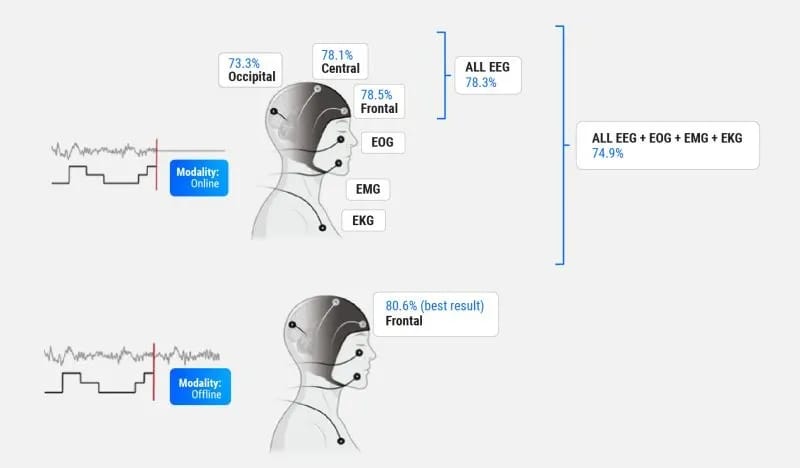
Performance was lower in participants with sleep apnea, highlighting the need to account for clinical populations when developing automatic sleep-scoring algorithms.
Overall, the findings support the development of simpler wearable and home-based sleep-monitoring technologies, as well as applications such as digital therapeutics and closed-loop neurostimulation. Further validation across larger and more diverse populations will be important for broader real-world adoption.
The study, “Automatic sleep scoring for real-time monitoring and stimulation in individuals with and without sleep apnea,” was authored by Martín Esparza-Iaizzo, María Sierra-Torralba, Jens Klinzing, Javier Minguez, Luis Montesano and Eduardo López Larraz.
Readers can access the full scientific publication.