Neuroarchitecture, EEG, and Brain Health in Built Environments: A conversation with Cleo Valentine
Schools, hospitals, offices, and homes shape far more than daily routines. Emerging research in neuroarchitecture and neuroscience suggests that built environments may also influence stress, attention, cognitive load, and long-term well-being.
In this edition of In the Lab, Cleo Valentine discusses how EEG research, biophilic design, and neuroimmunology are helping researchers better understand the relationship between architecture and human health.
A design researcher working at the intersection of architecture, neuroscience, and neuroimmunology, Cleo holds roles at HKS, the Harvard T.H. Chan School of Public Health, and the University of Cambridge, where she is affiliated with the Department of Architecture following her previous work as a Visiting Researcher at the Design Engineering Centre. She also leads innovation at the UCL RISE Centre for Neuroarchitecture and NeuroDesign. For her research, Cleo works with Bitbrain’s Versatile EEG, a portable, wireless, water-based system that requires no gel and no lengthy setup, making it well suited to the kind of real-world, in-context research her work demands.
For this edition of our In the Lab series, we spoke with Cleo about what EEG is beginning to reveal about the spaces we inhabit, and why the stakes of getting design right are higher than most people realize.

Cleo Valentine is a design researcher specializing in architectural neuroimmunology and neuroarchitectural bioethics.
What does it mean to study how space affects stress, cognition and health?
Most conversations about architecture center on aesthetics or function. How a space looks, or how efficiently it works. Cleo’s starting point is different.
“I usually start by saying that I study how the built environment affects the body, not just how it looks or feels, but how it is processed biologically over time.”
Her path into this field began with a realization that architectural elements most people treat as background, light, pattern, scale, the rhythm and composition of a façade, are anything but neutral for the nervous system.
“They shape attention, arousal, and stress in ways that accumulate across the day.”
That insight led her from architecture into neuroscience and eventually into neuroimmunology, where chronic stress has measurable downstream effects on inflammation and long-term health. But underpinning all of it is a question that is as ethical as it is scientific.
“So the work is about more than mechanisms. It is about responsibility. If design decisions have biological consequences, they carry ethical weight. The question is not just what we build, but what we are quietly asking the body to endure.”
The invisible load of everyday environments
One of the most important shifts Cleo wants people to recognize that health is not only about individual choices. Diet, exercise, and sleep are the variables we typically focus on. But most of our waking hours are spent inside environments we did not choose and cannot easily modify.
“The most important shift, for me, is recognizing that the built environment is not a neutral backdrop. It is an active exposure, one that shapes how hard the brain and body have to work just to maintain stability.”
And the effects are rarely the kind you notice in the moment. Instead, they accumulate.
“The second insight is that stress here is rarely dramatic. It is subtle and cumulative. Visual noise without structure. Poor legibility. Sensory imbalance. These are small, continuous demands that keep the nervous system in a slightly elevated state, not enough to notice moment to moment, but enough to matter over time.”
Recent research in this field is beginning to show that these effects are not just theoretical, but measurable. In her 2024 systematic review on architectural form and physiological stress, Cleo highlights how environmental features such as visual complexity, spatial coherence, and enclosure can influence biomarkers, including heart rate variability, skin conductance, and cortisol regulation, all well-established indicators of physiological stress responses (Valentine, 2024).
In parallel, emerging work in architectural neuroimmunology is beginning to explore how these environmental exposures may extend beyond immediate stress responses and into longer-term biological processes. In a recent pilot study on biophilic design, Cleo and her collaborators examined how exposure to different architectural environments may relate to markers associated with neuroinflammation (Valentine, Steffert, Mitcheltree, & Steemers, 2024). While still early, this line of research suggests that the environments we inhabit could play a role not only in how we feel, but in how the brain and immune system interact progressively.
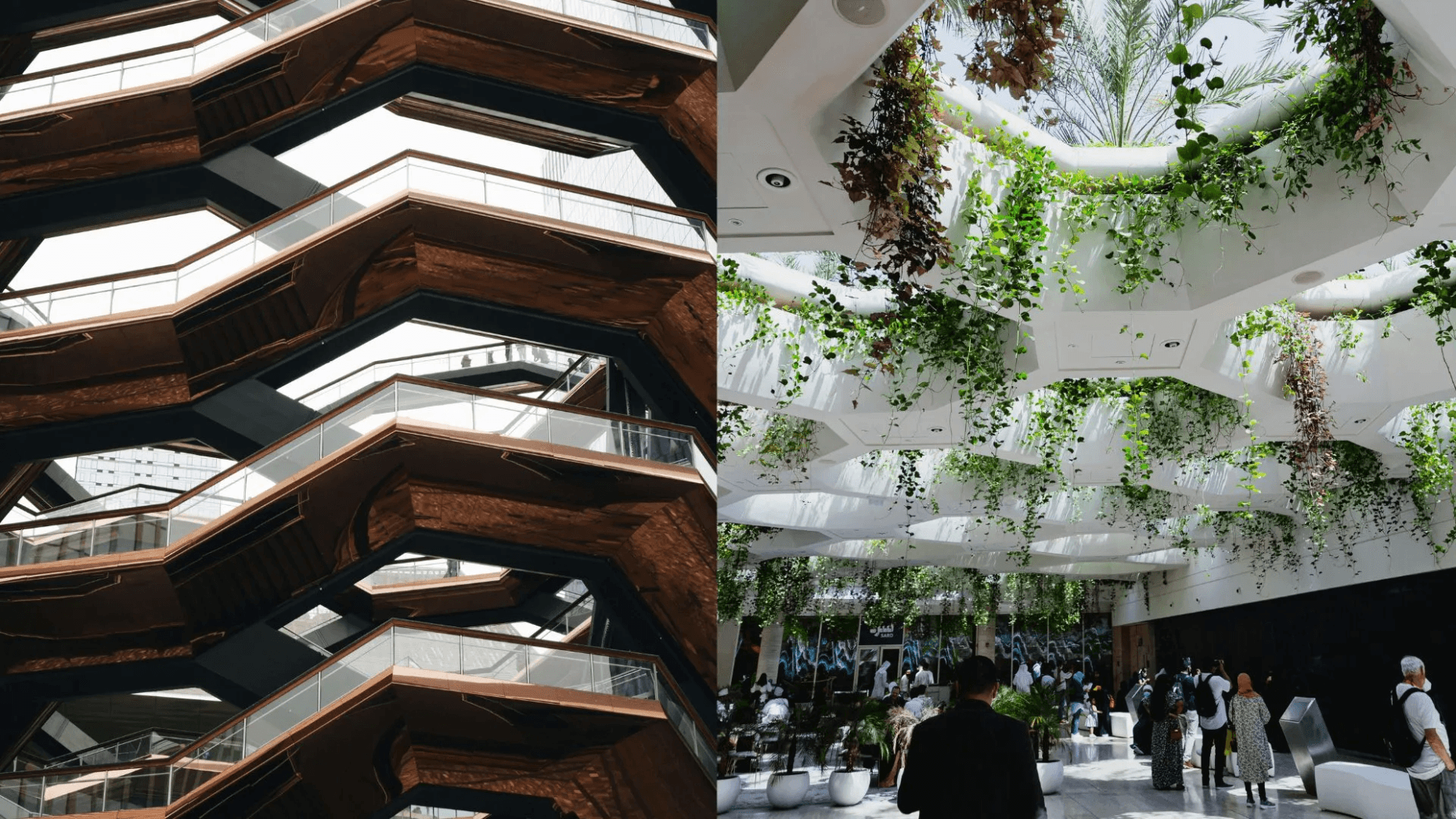 On the left, a space without biophilic design; on the right, a biophilic space.
This is part of why biophilic design has gained traction in research settings. It may be less about adding something enriching and more about restoring conditions the human brain is already equipped to handle efficiently.
“Biophilic design is interesting for this reason: it may not be adding something special so much as reintroducing conditions the human perceptual system is already well adapted to process. Natural patterns, multi-scale variation, and coherent structure tend to reduce unnecessary cognitive load, which supports regulation rather than taxing it. We evolved in these conditions. The brain knows how to handle them.”
The implication for how we design schools, hospitals, and workplaces is significant. The question shifts from what is easiest or cheapest to build to what genuinely allows the body to function and recover.
What EEG is beginning to reveal about architecture and brain activity, and what it cannot yet tell us
This is where neurotechnology enters the picture. Cleo’s research includes preliminary EEG work examining how architectural environments are registered in neural activity, which she describes as promising but requiring careful interpretation.
“There is a real sense of momentum in this field right now. The tools to study how the built environment affects the brain and body are finally becoming viable at meaningful scales.”
In one early study focused on biophilic environments, conducted using Bitbrain’s Versatile EEG, signals began to emerge.
“In my own research, including an initial study on biophilic environments, we saw early indications that architectural conditions can be reflected in neural dynamics. These findings are still exploratory, but they may point to a relationship that is worth pursuing.”
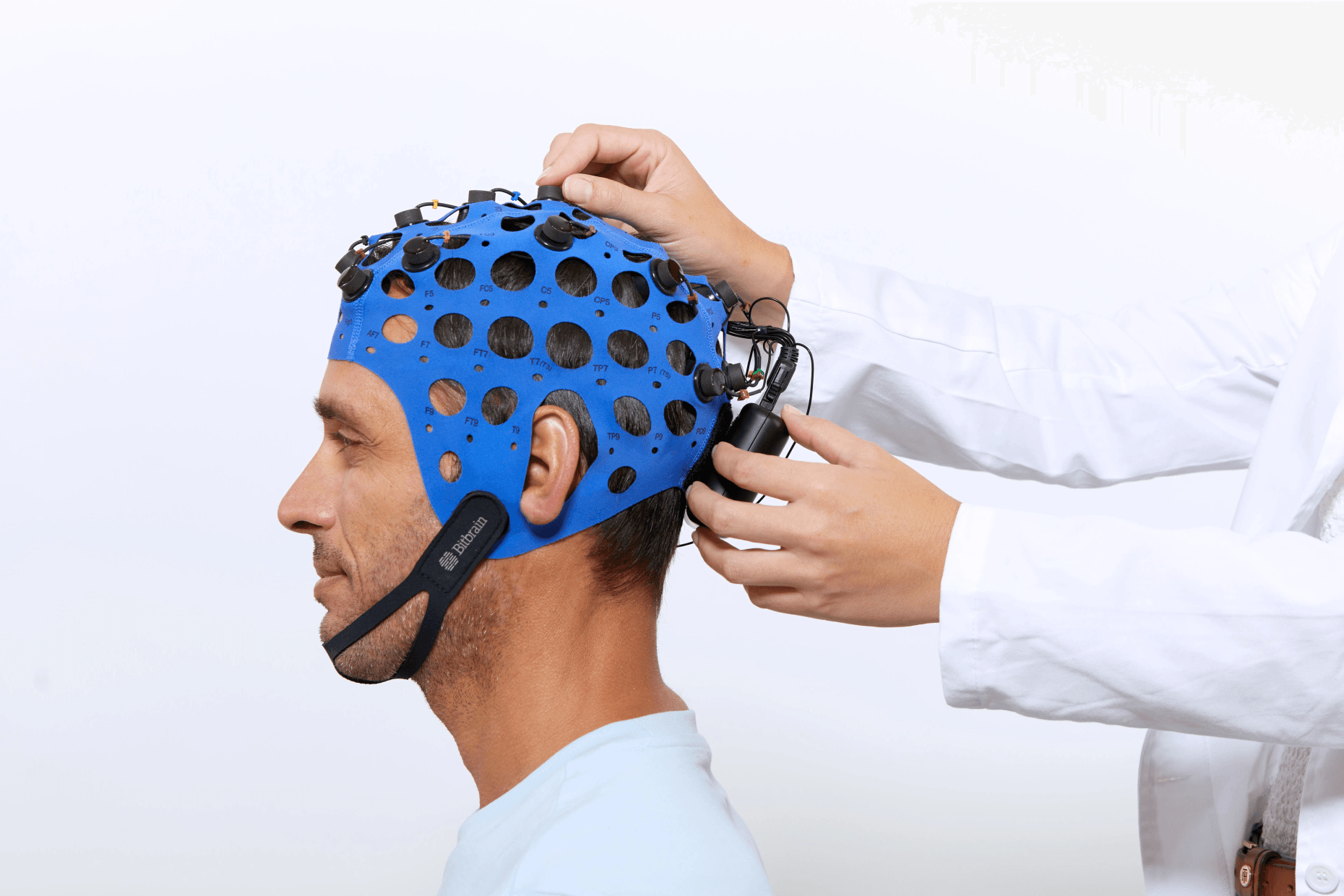 Bitbrain Versatile EEG
But Cleo is measured about what that means. EEG data does not interpret itself, and the gap between a signal and a conclusion is wide.
“These tools are powerful, but they do not speak for themselves. They require strong theoretical grounding and a disciplined approach to what is being measured, and what can reasonably be inferred.”
The next challenge is moving these insights out of controlled laboratory conditions and into the real, complex texture of lived environments.
“Laboratory studies are essential for isolating mechanisms, but architecture is experienced over time, in context, and alongside many interacting variables. We need more work that connects these controlled insights to real-world settings through immersive environments, longitudinal studies, and multi-modal approaches that combine neural, physiological, and experiential data.”
This is a philosophy we strongly share at Bitbrain. The development of the Versatile EEG is grounded not only in signal quality, but in usability and real-world applicability. Wireless, portable, and ready to use with just water, it removes the practical barriers that have historically kept EEG research confined to the lab. As research moves into more ecological settings, tools that balance robustness, flexibility, and ease of use become essential to support innovative work like Cleo’s.
 Outdoor data collection using Bitbrain’s Diadem 12-channel EEG and eye tracking system (Tobii Glasses 3).
How this research changes how you experience a room
We asked Cleo whether this work had changed how she thinks about her own surroundings. The answer was yes, though perhaps not in the ways you might expect.
“It has made me much more attentive to things I might once have overlooked. I think less about individual elements in isolation, and more about how they relate to one another. How visual information is organised, how the eye moves through a space, how light functions not just as illumination, but as a regulator of rhythm, attention, and recovery. I also think more consciously about creating environments that allow for both engagement and retreat, rather than maintaining a constant level of stimulation.”
In practice, the changes she makes are quiet ones, reductions rather than additions.
“In my own spaces, the changes I make are rarely dramatic. It is often about reduction and calibration rather than addition. Reducing unnecessary visual clutter. Introducing materials or patterns that have some variation, but also a sense of structure. Being more deliberate about transitions, between brightness and shadow, between activity and quiet, between spaces that ask something of you and spaces that allow the system to settle.”
At the heart of all of it is a single guiding idea.
“The underlying principle is not perfection, it is efficiency in its truest sense. If a space requires less effort for your brain to process, that capacity is freed up for everything else you need to do. That is not a small thing. It compounds across every hour you spend in that environment.”
This perspective becomes especially important in environments where sustained attention and performance are required, such as workplaces, schools, or research settings. The quality of the environment may directly influence how much cognitive capacity is available for meaningful work. (Joye et al., 2022; Chulvi et al., 2019; Schertz et al., 2022)
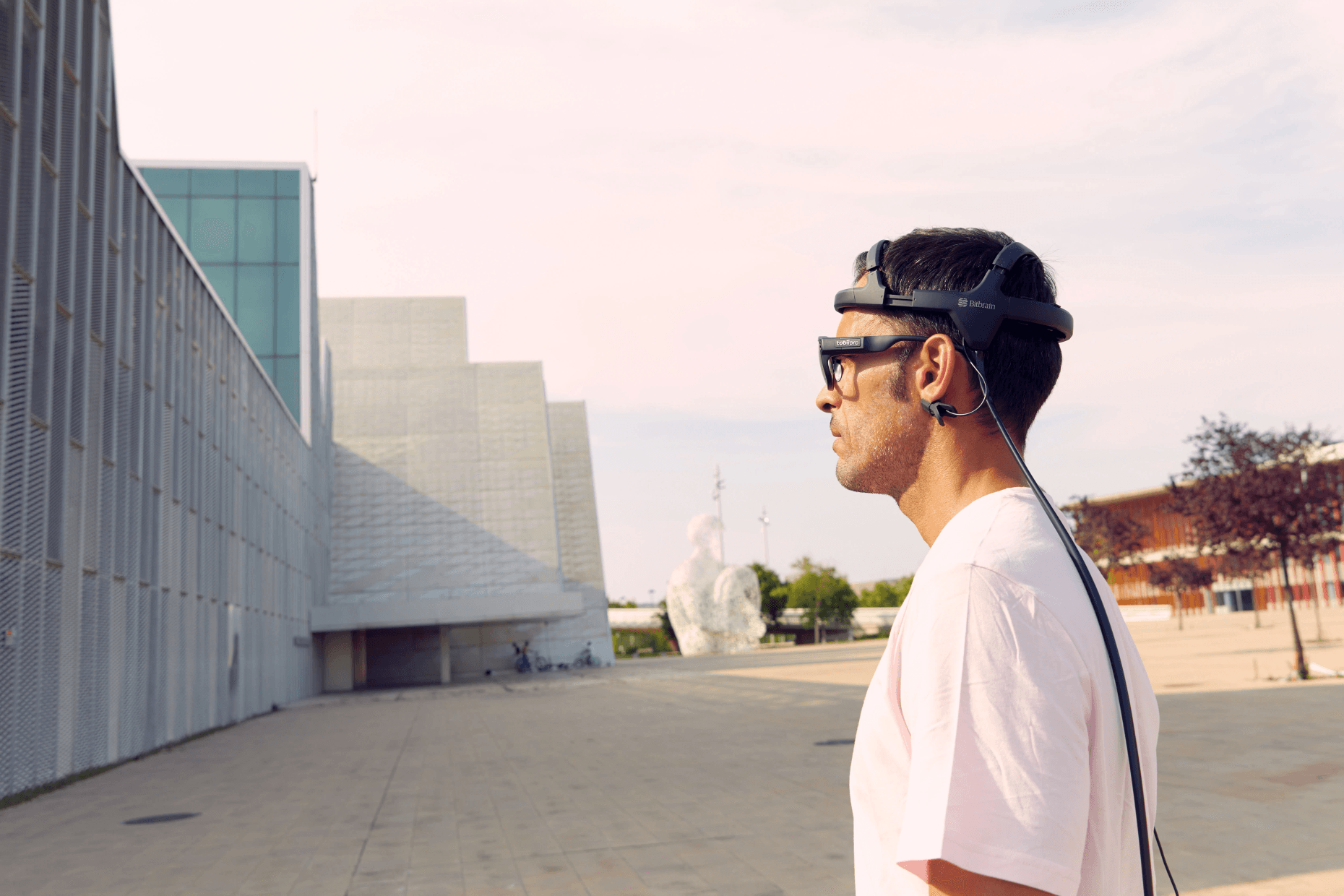 In the image, Bitbrain Diadem EEG and Tobii Glasses 3, Tobii eye-tracking systems.
Cleo is also clear that she does not approach this work as a designer or a scientist in isolation, but from a position that sits at the intersection of disciplines. It is precisely this in-between space that gives her work its depth. In many ways, she represents a new kind of researcher, one that reflects what modern science increasingly demands. Not specialization at the expense of everything else, but integration. A way of thinking that recognizes that the most meaningful questions do not belong to a single field. They exist at the intersection. In that sense, her work speaks not only to the future of architecture or neuroscience but to a broader shift in how we understand knowledge itself. That everything is, ultimately, interconnected.
She also emphasizes that collaboration is not optional in this kind of work. It is essential. Progress depends on researchers, designers, engineers, and clinicians working together across fields, testing assumptions and learning from one another as the science develops.
At Bitbrain, we see this same principle reflected in how neurotechnology advances. The tools that make research like Cleo’s possible are themselves the product of close collaboration between scientists, engineers, and the research community, built to translate scientific needs into instruments that work in the real world.
What comes next for neuroarchitecture research
Cleo is the first to acknowledge the limits of what is currently known. Her work sits across disciplines, architecture, neuroscience, and health, and she sees that position not as a weakness but as precisely where its value lies.
“It is important to be clear about what we know, but even more important to recognize what we do not.”
What she is certain of is that this research matters, and that pursuing it with rigor, humility, and openness across disciplines is what will allow it to make a genuine difference.
“It is such a privilege to get to work on a topic that has the potential to meaningfully support health and wellness, and something I am very grateful for.”
Architecture has always shaped how we live. What is becoming clear, through tools like the Versatile EEG and researchers willing to use them in unconventional ways, is that it also shapes how we think, how we feel, and how our bodies hold up over time. At Bitbrain, supporting that work is exactly what we are here for.
About the author
Almudena Robledo is a health biologist and neuroscientist specializing in sleep and neurotechnology. Her research experience spans from animal studies on autism to digital therapies for Alzheimer's disease. Currently, she works as a Product Manager at Bitbrain, contributing to the development of innovative neurotechnology solutions created by researchers for researchers.
You might also be interested in:
- Architectural Neuroimmunology: Do buildings impact the brain via the immune system?
- Exploring the Science of Mind Wandering with Dr. Julia Kam
- A Window into the Social Brain: How Collective Rituals Shape Neural Connection
- What is EEG and what is it used for?
- EEG and Multimodal Research in Neuroscience: Technologies, Tools and Techniques
- EEG and Virtual Reality: The Neuroadaptive Future of Neurotechnology
References
Valentine, C. (2024). The impact of architectural form on physiological stress: A systematic review. Frontiers in Computer Science. https://doi.org/10.3389/fcomp.2023.1237531
Valentine, C., Steffert, T., Mitcheltree, H., & Steemers, K. (2024). Architectural neuroimmunology: A pilot study examining the impact of biophilic architectural design on neuroinflammation. Buildings. https://doi.org/10.3390/buildings14051292
Joye, Y., Lange, F., & Fischer, M. (2022). Does beautiful nature motivate to work? Outlining an alternative pathway to nature-induced cognitive performance benefits. New Ideas in Psychology, 66, 100946. https://doi.org/10.1016/j.newideapsych.2022.100946
Chulvi, V., Agost, M. J., Felip, F., & Gual, J. (2019). Natural elements in the designer's work environment influence the creativity of their results. Journal of Building Engineering, 101033. https://doi.org/10.1016/j.jobe.2019.101033
Schertz, K. E., Bowman, J. E., Kotabe, H. P., Layden, E. A., Zhen, J., Lakhtakia, T., Lyu, M., Paraschos, O. A., Van Hedger, S. C., Rim, N. W., Vohs, K. D., & Berman, M. G. (2022). Environmental influences on affect and cognition: A study of natural and commercial semi-public spaces. Journal of Environmental Psychology, 84, 101852. https://doi.org/10.1016/j.jenvp.2022.101852