How We Study Our Decisions: Aroa Costa Feito and the neuroscience of human behavior
We make decisions throughout the day, from choosing what to wear in the morning to deciding what to do with our savings. Some require time and deliberation; others happen almost without our noticing. Studying how context, attention and emotions influence those choices is one of the challenges of human behavior research.
In this edition of In the Lab with, we talk to Dr. Aroa Costa Feito, researcher and lecturer at the University of León, about how decision-making is studied: what combining neurotechnology and traditional research methods brings, and what changes when studies leave the laboratory.
Her work sits at the intersection of marketing, tourism and consumer neuroscience. Aroa investigates how we respond to different stimuli and how cognitive and emotional processes influence our behavior.

Aroa Costa Feito, PhD in Consumer Neuroscience, researcher and lecturer at the University of León.
Her career began in market research, and she later specialized in cognitive and affective neuroscience and in tourism. Over time, her interests also expanded to people's relationship with nature conservation.
Her background has allowed her to study what happens behind our decisions, especially those processes that occur quickly and automatically and that we are not always able to explain.
She is part of the Tourism and Protected Areas Specialist Group (TAPAS), part of the World Commission on Protected Areas (WCPA) of the International Union for Conservation of Nature (IUCN).
From Market Research to the Neuroscience of Human Behavior
Neuroscience is increasingly expanding its frontiers and finding new applications in diverse fields, exploring human behavior through the study of the brain and body. Many researchers are bringing their methodologies to sectors that have so far been little explored. In Aroa's case, her interest in these tools arose during her professional career in market research:
"It was precisely while working with traditional market research methods that I realized there are processes that happen much more quickly and automatically, and that we are not always able to verbalize."
That interest led her to incorporate new tools into her research to complement traditional methods and explore aspects of behavior that we cannot always explain consciously.
"That is where neuroscience came in, as a scientific and objective method that allowed me to go one step further and study human behavior."
These questions took shape in the study of audiovisual tourism stimuli:
"During my doctorate, I focused especially on how audiovisual tourism stimuli capture attention, generate emotional responses and are stored in memory, and how all of this can end up influencing the intention to travel and the decision-making itself about the travel destination."
This line of research is presented in a study on cognitive and emotional responses to short tourism videos and their relationship with travel intention (Costa-Feito, Rodríguez-Santos, González-Fernández and Marques dos Santos, 2025), which the team also explains in this popular-science article from Fundación Muy Interesante.
Why Combine Neurotechnology and Traditional Research Methods
Analyzing different dimensions of human behavior broadens our perspective, but having more data does not necessarily mean reaching better conclusions.
A single indicator can offer a partial view and, at times, even lead to erroneous interpretations. To understand what is happening, it is necessary to relate and contrast different measures. Aroa explains how, in neuroscience applied to human behavior, this joint reading is essential:
"I would not frame neurotechnology as a substitute for self-reported measures such as surveys, in-depth interviews or other market research methods, but as an additional piece that allows us to observe another part of the decision-making process and obtain a broader and more complete view of the consumer."

Combination of a focus group with galvanic skin response (GSR) recording. Photo: Bitbrain.
In this sense, each method provides different information about the decision-making process.
"When we ask a person what they felt, what they remember or what caught their attention, we are accessing their conscious experience and their ability to explain it. That is fundamental. But there are cognitive and emotional processes that are very fast, hard to verbalize and that a person does not process consciously, yet they are truly relevant for understanding and explaining human behavior."
Aroa and her team combine different techniques and technologies to record neurophysiological signals and contrast them with what people report about their experience.
"On the other hand, when we combine signals from EEG, GSR and eye-tracking technologies, for example, together with what the person consciously reports, we may find a consistent pattern or, conversely, that a person declares themselves very inclined to carry out a certain behavior because of the social norms they are exposed to (for example, buying organic products), but if we analyzed their response in a purchasing situation we would observe that other factors carry more weight (price, taste, convenience…)."
"However, saying that the brain tells us the truth and the survey lies would be an oversimplification. Each method measures a different dimension of behavior. The key is to triangulate the information and understand how the conscious, the implicit, the cognitive and the emotional interact."
This combination of methods is aligned with Bitbrain's multimodal vision and is present in many of our projects, such as the study carried out with Fundación MAPFRE on road safety campaigns. In this work, participants' self-reported responses were contrasted with EEG, GSR and eye-tracking recordings, as well as with the results of an implicit association test. The case illustrates how different measures can provide complementary information about the same experience.
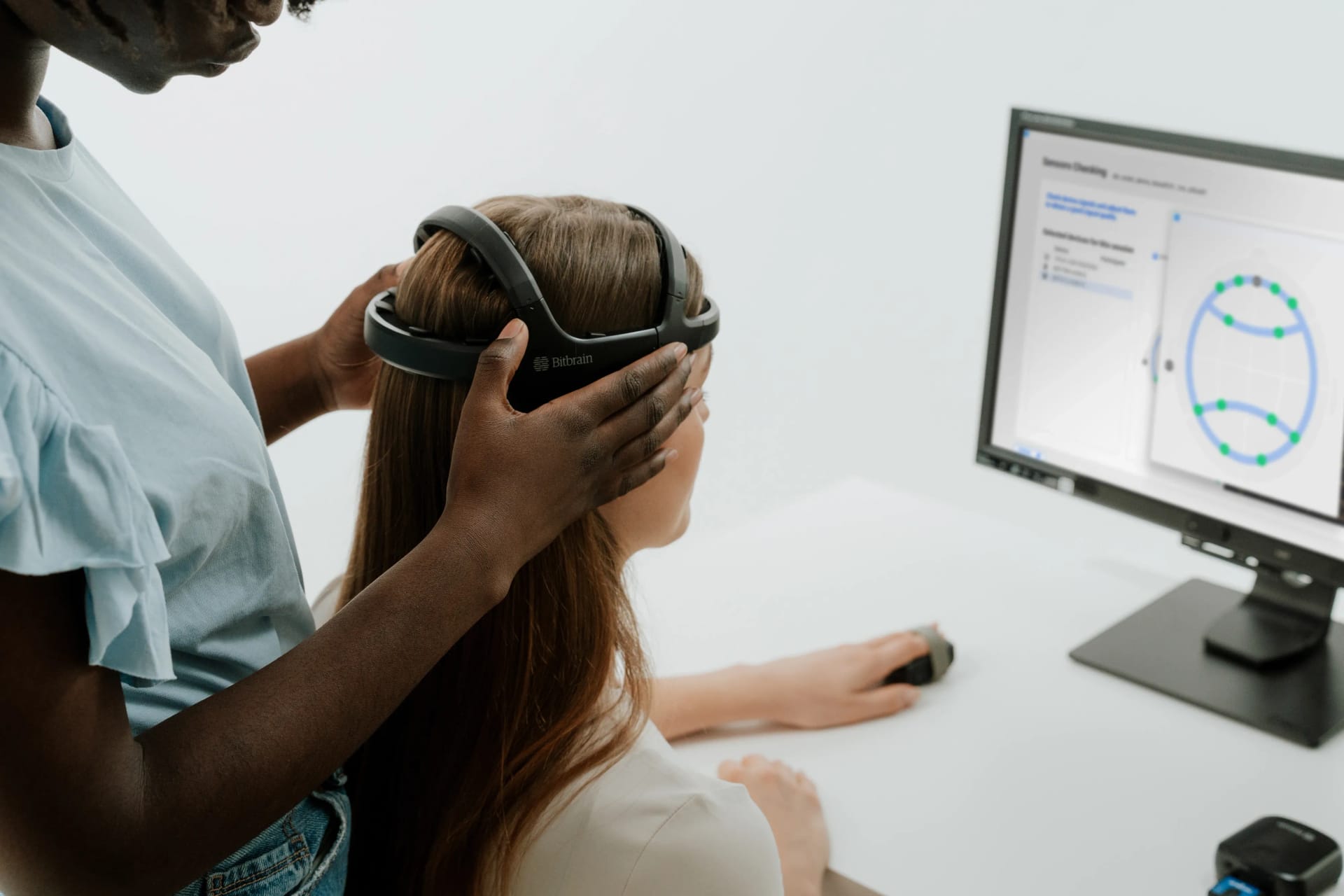
Multimodal laboratory recording with stationary eye-tracking, EEG and GSR. Photo: Bitbrain.
From the Laboratory to Real-World Studies: Tourism
Traveling is not just about arriving at a destination. Every experience, from the first contact to the last memory, influences how we perceive and remember it. Tourism is precisely one of the fields on which Aroa focuses her research, a field in which studying what happens outside the laboratory is especially relevant.
In this interview, Aroa shares a case in which research leaves the laboratory and confronts the particularities of the real world:
"An example that represents this line of work very well is a recent study we are developing in collaboration with the Basque Coast UNESCO Global Geopark. In this case we want to study what happens emotionally and cognitively during a real tourist experience and whether there are differences between experiencing it in a guided or unguided way."

Multimodal recording with EEG and eye-tracking at the Basque Coast Geopark. Image courtesy of Aroa Costa-Feito.
"To do so, we combine eye-tracking, EEG and GSR, together with self-reported measures. The idea is not to stick solely with what visitors say after the experience, but to try to observe how they respond while they are living it: which points along the route (scenic, geological, communicative…) capture their attention, which moments generate greater emotional activation and which elements they manage to remember."

Example of a multimodal outdoor recording with EEG technology and eye-tracking systems. Photo: Bitbrain.
Outside the laboratory, external stimuli and hard-to-control variables can affect the quality of neurophysiological signals. For this reason, rigor depends not only on the technology, but also on anticipating these difficulties and adapting the experimental design to minimize their impact.
"This is especially interesting because the laboratory allows us to control many variables, but a real tourist experience has greater validity, although it is far more complex. There is movement, conversations, changes in lighting and weather, sounds, people walking in front of you, and so on. All of this can generate artifacts in the physiological signals. Working outside the laboratory requires being much more rigorous in the design of the protocol, in data collection and in data processing."
"I believe that is precisely where one of the great advantages of multimodality lies. No single signal gives us all the answers. When different measures point in the same direction, we can have a much more solid interpretation of what is happening during the experience."
Where Neurotechnology Is Heading: From Data to Understanding
At Bitbrain we work to bring neurotechnology to new fields and professional profiles, keeping scientific rigor as our guiding principle. Improvements in usability, along with other technological advances, expand research possibilities. Aroa highlights both the opportunities they offer and the challenges of interpreting the information obtained:
"I think we are in a particularly interesting moment for neurotechnology. One of its main advantages is that it allows us to study human behavior with excellent temporal and physiological resolution. In addition, we increasingly have devices that are less intrusive, more accessible, easy to use and able to be applied outside the laboratory. However, having physiological signals does not automatically mean knowing what a person is processing."

Example of a multimodal recording in a real environment with EEG technology and eye-tracking systems. Photo: Bitbrain.
Applying neurotechnology goes far beyond collecting physiological signals. It requires knowing what you want to measure, how to do it and how to interpret the data obtained.
"A given response does not have a single, universal meaning, and we always need context, a good experimental design and rigorous interpretation. Moreover, working with several signals generates large amounts of data and requires significant methodological and statistical knowledge."
Among technological advances, artificial intelligence offers new possibilities for working with that data. We asked Aroa what it can contribute to research and how it influences the role of the researcher:
"In this regard, I think AI can be a great ally. It helps process large volumes of information, identify complex patterns or integrate different data sources that would be very difficult to analyze manually. The more automated the analysis is, the more important the researcher's role becomes in deciding which questions to ask, how to design experiments well and whether the pattern we find truly makes sense from a scientific point of view."
What We Have Learned and What Is Yet to Be Discovered: A Path in Applied Neuroscience
Aroa's career has allowed her to study human behavior in fields such as marketing, food, tourism and nature conservation. We asked her what changes between these fields and what lessons they share.
"Although they may sound like very different fields, they all have something in common: we want to understand why people make certain decisions and which factors can favor a change in behavior. The main difference lies in the context and, above all, in the type of behavior we want to explain.
In marketing or tourism we may be studying, for example, which elements of a communication manage to capture attention, generate emotion or improve the memorability of a destination.
In nature conservation, on the other hand, the question can be much more complex, since it is not enough to achieve an emotional reaction; we need to know whether that reaction can subsequently translate into pro-environmental behavior."
These differences are also reflected in the design of the study:
"This also changes the way experiments are designed. It is not the same to measure the response to an advertisement as to study how a person reacts to images of threatened marine species, and whether that experience can influence their decision to make a donation or take part in conservation actions."
This experience across different fields has also shaped her way of doing research.
"One of the best lessons I have learned has been precisely the chance to apply neuroscience in different fields, because we must adapt experimental designs in great detail from one context to another. We have to understand very well what we want to measure, what a given response means in that context and what behavior we want to explain. And I believe that this interdisciplinarity is one of the most enriching parts of my work. The same tool can help us answer very different questions, but the real challenge lies in designing the study well so that the data have sense and meaning."

Person in a natural setting. Illustrative image: maxbelchenko / Shutterstock.
Looking ahead, Aroa wants to bring what she has learned in tourism to new questions about our relationship with nature:
"In the coming years I would like to continue moving toward a neuroscience applied to behavior change, especially in the field of biodiversity conservation and tourism."
"Until now, a large part of my research has focused on understanding how certain tourism stimuli influence attention, emotions, memory and the decision to travel. Now I am interested in taking a step further and using that knowledge to study how we can connect better with conservation and promote truly pro-environmental behaviors."
To close the interview, we asked her for advice for those who want to pursue research in human behavior and applied neuroscience:
"If I had to give advice to someone just starting out in the field, it would be to train in a cross-disciplinary way. This discipline lies precisely at the intersection of several disciplines (neuroscience, psychology and the field or fields in which one wants to apply one's research…), so knowing about behavior, research methodology, statistics and neuroscience is much more useful than limiting yourself to knowing how to use devices."
From the laboratory to a real tourist experience, from marketing to conservation, the challenge remains the same: turning technology into knowledge, and that knowledge into new ways of understanding human behavior.
About the Author
Diego Apellániz holds a degree in Marketing and Market Research and a master's degree in Neuromarketing and Consumer Behavior. At Bitbrain, he takes part in projects that use neurotechnology to study human behavior. He also advises and trains researchers in the use of the technology, the design of experimental protocols and the interpretation of results, adapting methodologies to their research questions.
Related Posts
- Neuroarchitecture, EEG, and Brain Health in Built Environments: A conversation with Cleo Valentine: Discover what EEG reveals about how the spaces we live in affect our stress, nervous system and long-term health.
- IAT and Priming Tests: Advances in Neuroscience and EEG Technology: Learn how neuroscience and EEG are expanding the tools used to study implicit bias and automatic associations.
- Exploring the Science of Mind Wandering with Dr. Julia Kam: Explore how mind wandering shapes our attention, creativity and well-being through real-life EEG research.
- A Window into the Social Brain: How Collective Rituals Shape Neural Connection: Find out how collective rituals like prayer and meditation affect the brain and body, measured with mobile EEG.
- Are we influenced by product placement while playing video games?: Discover how brands in video games affect the brain and physiological responses of players.
- EEG and Virtual Reality: The Neuroadaptive Future of Neurotechnology: See how combining EEG and VR can measure attention, emotion and fatigue to adapt digital experiences in real time.
- How Eye Tracking Works: Technology, Methods and Applications Explained: Learn how eye tracking works and how it is used in research, UX, neuromarketing and medical screening.
References
• Costa-Feito, A., Rodríguez-Santos, C., González-Fernández, A. M., & Marques dos Santos, J. P. (2025). The emotional paradox of short promotional videos in urban tourism: cognitive and affective responses in decision-making under stress or joy. Journal of Travel & Tourism Marketing, 42(5), 708–723. doi: https://www.tandfonline.com/doi/abs/10.1080/10548408.2025.2505890