Not science fiction: how a P300 brain-computer interface brought EEG from the lab to the classroom
Can a computer figure out which number you are thinking of, just by reading your brain? It sounds like science fiction, but it is a real, well-understood technique, and this spring it filled a room in Granada with secondary-school students.
A team at the University of Granada used a Bitbrain Versatile EEG system to run exactly this experiment: guessing a digit a volunteer had silently chosen, using nothing but their brain activity. What began as a final-year engineering thesis became a science-outreach demonstration seen by close to a hundred teenagers, and it made local news. Here is what the technology actually does, and why it travelled so well outside the lab.
The P300: a brain signal you can put to work
When you see something, your brain produces a small, predictable electrical response a few hundred milliseconds later, which an EEG can record from the scalp. These visual evoked responses are so well characterised that they are used as a standard clinical measure of the visual system (Odom et al., 2016). One particular component is the P300: a positive deflection in the EEG that appears around 300 milliseconds after a meaningful or unexpected event, and one of the most studied signals in cognitive neuroscience (Picton, 1992). It gets noticeably larger when something catches your attention.
This is the basis of a classic “oddball” setup: show a stream of items, ask a person to focus on one of them silently, and the brain marks that item with a bigger P300 every time it appears (Picton, 1992). Measure where and when the P300 is largest, and you can infer what the person was paying attention to.
That simple principal powers some of the most meaningful applications in neurotechnology. P300-based brain-computer interfaces let people with severe paralysis spell words letter by letter, drive a wheelchair, or control a device with attention alone. It is a clear example of how EEG can be used not only to study the brain, but to interact with the world through it.
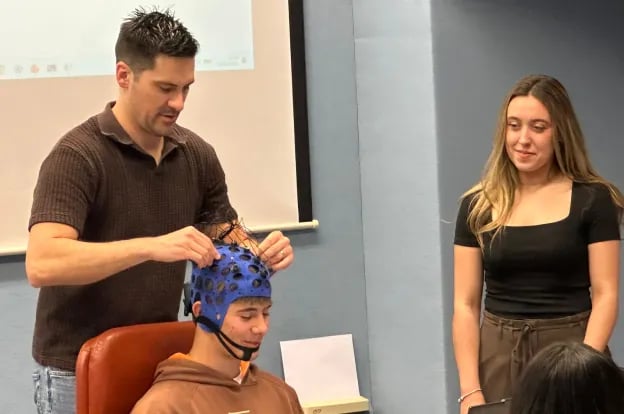
 Figura 1. Students attending an educational demonstration on electroencephalography (EEG) and the P300 brain signal.
A student project at the University of Granada
This work from the University of Granada started as a thesis by Marta Rodríguez Comino, a final-year student in Industrial Electronic Engineering, supervised by Dr. Joaquín T. Valderrama and Dr. Iván López Espejo, both Ramón y Cajal researchers in the Department of Signal Theory, Telematics and Communications.
 Figure 2. Marta Rodríguez Comino, Iván López, and Joaquín T. Valderrama during a talk on EEG and the P300 brain signal presented to a group of students.
The goal was to identify which digit, from 0 to 9, a person was silently attending to. Digits appeared on a screen one after another, and the volunteer was asked to do just one thing: silently count how many times their chosen digit came up (Rodríguez Comino, 2026). That counting is what keeps attention fixed on a single digit, and it is the key to the method.
Why does that produce a bigger P300? The chosen digit appears only occasionally, mixed in among all the others (in this study it was the target just one time in ten; Why does that produce a bigger P300? The chosen digit appears only occasionally, mixed in among all the others (in this study it was the target just one time in ten; Rodríguez Comino, 2026). Each time it does come up, it is both rare and personally meaningful, the one thing the volunteer is tracking, and the brain reacts to that combination with a stronger P300. The response only appears when the person is actively engaged in the task, and the rarer the target, the larger it grows (Picton, 1992; Polich, 2007). The ignored digits produce only a small response. The signal does not grow because of anything about the number itself, but because of the attention the person is paying to it.
“Larger” here means a bigger voltage: the attended digit produces a deflection of greater amplitude, measured in microvolts (millionths of a volt), strongest toward the back of the head over the brain’s visual and parietal areas, as you would expect for a response to something seen (Rodríguez Comino, 2026). It also unfolds over a specific window. The P300 is generally understood to reflect the brain recognising and evaluating a meaningful event, a step that comes after its first, faster reaction to simply seeing the digit, which is why the enhancement appears from around 300 milliseconds (the reason for the name) and, depending on how much processing the stimulus demands, can extend to roughly 600 milliseconds (Picton, 1992; Polich, 2007).
To turn that difference into an automatic readout, the team used two standard tools: Principal Component Analysis to reduce the signals to their most informative parts, and a Support Vector Machine to learn the boundary between the attended digit and the rest (Rodríguez Comino, 2026).
%2520(1).webp&w=1920&q=80)
Figure 3. The visual evoked potentials elicited by the experimental stimuli, recorded from six central EEG channels. The averaged brain response shows its main components, with the P1, N1, P2 and P300 labelled in channel Pz and largest over the parietal and occipital sites.
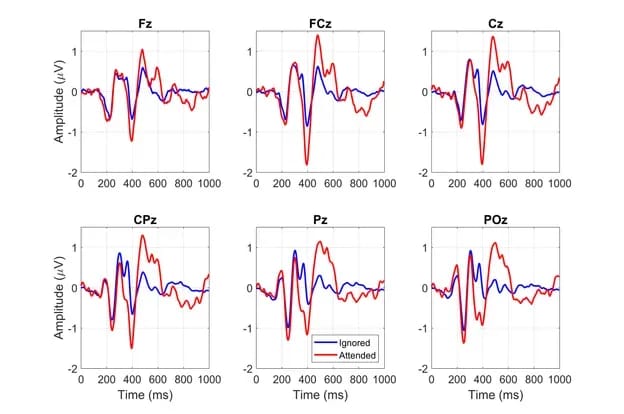
Figure 4. A comparison of the visual evoked potential elicited by the attended digit (red) with that elicited by the non-attended digits (blue). The attended digit stands out through a substantially larger P300 response.
NOTE: figures are the researchers' own.
Taking a research-grade EEG out of the lab
A demonstration like this only works if the equipment can leave the lab, set up quickly in front of a live audience, and record clean signals in a room full of movement and noise. That is where the hardware mattered.
The Versatile EEG uses water-based electrodes, which get a participant ready in just a few minutes. That speed is what makes a live demo possible at all: the cap goes on and the recording starts without a long, fiddly setup while an audience waits. The electrodes are also easy to clean and stay stable over long sessions, so the team could run the activity again and again through a busy event without signal quality drifting.
Accurate timing matters just as much in a P300 experiment. Because the P300 is defined by when it happens, about 300 milliseconds after each digit, the EEG has to be lined up precisely with the moment each digit appears on screen. Even small timing errors would smear the averaged response and could hide the P300 altogether.
The team kept the two in step using a Lab Streaming Layer protocol, which stamps the brain signals and the on-screen digits onto a shared clock, and then processed the data in MATLAB, a workflow they described as straightforward and quick to take from raw signal to a visible result.
Taken together, fast and comfortable setup, stable signal quality, and precise timing inside and outside the lab are what turned a thesis into something that could tour a school.
Why we love seeing this
At Bitbrain, we build EEG technology to be used in the real world, not only on the lab bench, and this project is a good reminder of how versatile that technology can be. The same water-based EEG that supports careful research can also run a live classroom demo in front of a hundred students. One platform, many very different use cases and settings.
There is a special value, too, in bringing EEG and BCI to young people who might one day train to become engineers and scientists. Marta built a working brain-computer interface as part of her degree, and close to a hundred students saw firsthand that this is real, approachable technology rather than something abstract or far off. Sharing that early, hands-on exposure can turn curiosity into a career.
Our thanks to Joaquín, Iván, and Marta for letting us follow along.
About the author
Almudena Robledo is a health biologist and neuroscientist specializing in sleep and neurotechnology. Her research experience spans from animal studies on autism to digital therapies for Alzheimer's disease. Currently, she works as a Product Manager at Bitbrain, contributing to the development of innovative neurotechnology solutions created by researchers for researchers.
Related resources
- What is EEG and what is it used for?: A beginner-friendly introduction to electroencephalography (EEG), explaining how brain activity is recorded and its main applications in medicine, neuroscience research, and neurotechnology.
- What is BCI? An Introduction to Brain-Computer Interface Using EEG Signals: Learn how brain-computer interfaces (BCIs) use EEG signals to enable direct communication between the brain and external devices, with applications in assistive technologies, rehabilitation, and human-machine interaction.
- EEG Neurotechnology for Human Enhancement and Rehabilitation: Explore how EEG-based neurotechnology supports motor and cognitive rehabilitation while also offering new possibilities for enhancing memory, attention, and overall human performance.
- Versatile EEG mobile water-based EEG (8/16/32 ch): A portable, wireless water-based EEG system that delivers high-quality brain recordings with a fast, gel-free setup, making it ideal for advanced neuroscience research and real-world studies.
- Versatile Plus EEG: Discover Bitbrain’s next-generation water-based EEG system, combining rapid setup, high signal quality, and flexible wired or wireless acquisition for research in both laboratory and real-world environments.
References
- Rodríguez Comino, M. (2026). Decodificación neuronal de la atención selectiva mediante señales de electroencefalografía [Trabajo Fin de Grado, Universidad de Granada]. DIGIBUG. https://hdl.handle.net/10481/114757
- Odom, J. V., Bach, M., Brigell, M., Holder, G. E., McCulloch, D. L., Mizota, A., & Tormene, A. P. (2016). ISCEV standard for clinical visual evoked potentials: (2016 update). Documenta Ophthalmologica, 133(1), 1-9. https://doi.org/10.1007/s10633-016-9553-y
- Picton TW. The P300 wave of the human event-related potential. J Clin Neurophysiol. 1992 Oct;9(4):456-79. https://doi.org/10.1097/00004691-199210000-00002 PMID: 1464675.
- Polich, J. (2007). Updating P300: An integrative theory of P3a and P3b. Clinical Neurophysiology, 118(10), 2128-2148. https://doi.org/10.1016/j.clinph.2007.04.019